Electric Scooters for Adults Around 300 lb
Which electric scooters list a payload high enough for riders near 300 lb, how weight affects range and braking, and which models on our list are not suited.
At a glance
For riders near 300 lb, the Segway SuperScooter GT3 is the only model on our list with a 330 lb load limit. The Segway Max G3 Plus and Max G3 are listed at 286 lb, so they fit only riders under that total weight, including gear.

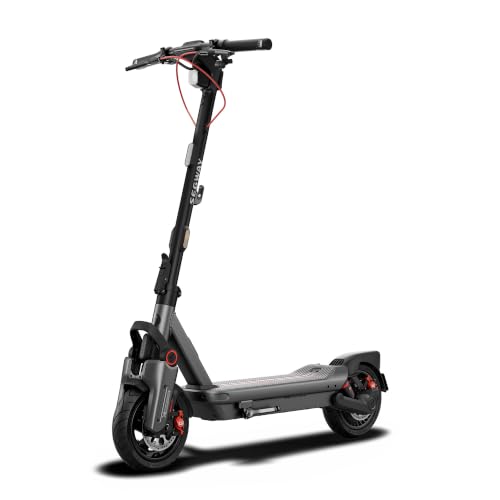

Most scooter shopping advice assumes a 165 lb rider. If you weigh 250, 280 or 300 lb, that assumption changes what you should buy. The number that matters most is not top speed or range. It is the maker’s maximum load, because that limit covers the frame, the brakes, the tires, the motor and the folding mechanism. This guide sorts our lineup by that number and is deliberately short on products.
We did not ride any of these scooters. Our analysis compares the specifications each maker publishes on its product page with general safety guidance. For the full lineup, see our electric scooter comparison.
Start With Your Real Number
Your weight for this purpose is not what the bathroom scale says in the morning. It is everything on the scooter: you, your clothes and shoes, a helmet, a backpack, a lock, a laptop. Weigh yourself holding the bag you will carry, and write the total down.
Then compare it to the maker’s maximum load, and leave margin. If your total is within a few pounds of the limit, treat the scooter as the wrong one. Motor power and a sturdy look do not change the limit. Never ride a scooter above its listed maximum load, and never assume you can get away with it by riding slowly.
How Weight Changes the Ride
Range. Segway’s range figures assume a 165 lb rider, about 77°F and flat pavement. The Segway SuperScooter GT3 is listed at about 45 miles in ECO and about 25 miles in SPORT and RACE under those conditions. A rider near 300 lb should expect less than the table suggests, particularly in the faster modes. A cautious plan uses well under half of the listed range for the round trip.
Hills. Segway lists a maximum slope of about 30 percent for the GT3, Max G3 Plus and Max G3, but Segway’s page does not say what rider weight that figure assumes. Expect a heavier rider to climb more slowly and to draw more from the battery on every hill. Plan hills into your range margin.
Braking. More mass takes more distance to stop. The makers publish no stopping distances for a loaded scooter, so the safe approach is to leave more space, use lower speed modes in traffic and check the brakes and pads regularly.
Tires. Segway lists 42 to 48 psi for the 11-inch tires on the GT3, Max G3 Plus and Max G3. A scooter carrying a heavy rider is less forgiving of a soft tire. Check pressure with a gauge, stay within the range in the manual and look for cuts or bulges before each ride.
Wear. Heavier riders add stress to tires, brakes and suspension. Inspect those parts often, and follow the maker’s maintenance guidance.
Tier 1: Riders Up to 286 lb Total Weight
Two Segway scooters are listed at a 286 lb maximum load. They are for riders whose total weight, including gear, is under that number. They are not for riders near 300 lb. If you are between about 250 and 286 lb, you have little margin, so read the specifications carefully and consider the next tier.
Segway Max G3 Plus: Longer Range, Up to 286 lb
Segway lists a 286 lb maximum load, a 717 Wh battery, hydraulic suspension at both ends and about 56 lb of weight. For riders whose total weight stays under 286 lb.
The Max G3 Plus has the larger of the two batteries, with Segway listing about 56 miles in ECO, about 36 in DRIVE, about 28 in SPORT and about 22 in SPORT+ at 28 mph, under the 165 lb rider conditions above. It has front and rear double-action piston disc brakes plus a rear electronic brake, and 11-inch self-sealing tubeless tires 2.8 inches wide. Segway’s page does not state a UL 2272 certification for this model, so ask the seller for documentation if your building requires it. See our Segway Max G3 Plus profile.
Segway Max G3: Same Limit, Smaller Battery
Segway lists a 286 lb maximum load, a 597 Wh battery, hydraulic suspension at both ends and about 54.2 lb of weight. For riders whose total weight stays under 286 lb.
The Max G3 is the earlier flagship, with about 50 miles in ECO, about 40 in DRIVE, about 34 in SPORT and about 25 in SPORT+ per Segway. It ships at about 20 mph, and Segway says about 28 mph is available after enabling High Speed in its app. Segway says it is certified by TÜV Rheinland to the UL 2272 standard and recommends riders aged 16 to 55 and at least 5’3” tall. See our Segway Max G3 profile.
Tier 2: Riders From 287 lb Up to 330 lb Total Weight
This is the only tier with a model on our list. If your total weight is above 286 lb, the Max G3 family is not an option for you, and on our list the only model with a higher limit is the GT3.
Segway SuperScooter GT3: 330 lb Maximum Load
Segway lists a 330 lb maximum load, an 899 Wh battery, a 2400 W peak motor and about 87.1 lb of weight. For riders under 330 lb total weight who have ground-level storage.
The GT3 pairs the 330 lb limit with a rear hub motor rated 1200 W nominal and 2400 W peak, front and rear disc brakes, 11-inch self-sealing tubeless tires and 7.2 inches of ground clearance. Segway lists IPX6, a recommended rider age of 18 to 60, rider height of about 5’3” to 6’7” and certification by TÜV Rheinland to the UL 2272 standard.
It comes with real trade-offs. At about 87.1 lb you roll it, you do not carry it. Segway lists about 6.5 hours to charge on 115 V. The top speed of about 31 mph is above many state and city limits, so check your local rules and use a lower mode where the law requires. If your total weight is near 330 lb, you have no margin, and this is not the right scooter. See our Segway SuperScooter GT3 profile.
Tier 3: Above 330 lb Total Weight
No scooter on our list is listed for a total weight above 330 lb, and we do not recommend one. Recheck the maker’s limits, and consider a different type of vehicle.
Not for Heavy Riders: Models With Lower Limits
These scooters are on our site, but their listed limits are too low for riders near 300 lb. We do not recommend them for that purpose.
| Scooter | Maximum load listed by the maker |
|---|---|
| Segway Max G2 | 265 lb |
| NIU KQi Air | 265 lb |
| Hiboy S2 Max | 220 lb |
| Hiboy S2 Pro | 220 lb |
| Segway Ninebot E2 Plus | 198 lb |
Safety Habits That Matter More at Higher Weight
- Wear a helmet and follow your state’s rules. Rules about helmets, age, speed and where you may ride vary by state and city.
- Charge safely. Cornell’s environmental health and safety office advises using the original charger and cord, not charging unattended or while sleeping, and keeping the device where it does not block your exit. It points to the UL 2272 standard for personal e-mobility devices.
- Avoid rough riding. The same page advises against jumping curbs and riding off-road, because damage can lead to a battery failure called thermal runaway.
- Inspect before each ride. Check tire pressure, brake feel, folding latch and bolts. A heavier rider puts more load on each of them.
- Keep speed in check. Use a lower speed mode in traffic, on wet pavement and on unfamiliar routes.
Sources
- Cornell Environmental Health and Safety: Fire Safety with Lithium-ion Mobility Devices
- Segway SuperScooter GT3 official product page
- Segway MAX G3 Plus official product page
- Segway Ninebot Max G3 official product page
- Segway Ninebot KickScooter Max G2 official product page
- Segway Ninebot E2 Plus official product page
- NIU KQi Air official product page
- Hiboy S2 Max official product page
- Hiboy S2 Pro official product page
Frequently asked questions
What electric scooter holds a 300 lb rider?
On our list, only the Segway SuperScooter GT3, which Segway lists with a maximum load of 330 lb. The Segway Max G3 Plus and Max G3 are listed at 286 lb, so they are not for riders near 300 lb. The maximum load covers you plus clothing, a helmet and anything you carry.
Does rider weight affect range?
Yes. Segway's range figures assume a 165 lb rider, about 77°F and flat pavement. A heavier rider asks more of the motor and battery, so expect less range than the listed number, especially on hills and at higher speeds. Plan your round trip on well under half of the listed range.
Can I ride a scooter above its weight limit if I go slowly?
No. The maximum load is the maker's limit for the frame, brakes, tires and motor, and exceeding it is not safe or covered by the maker's guidance. If your total weight is above a model's limit, choose a different scooter or a different type of vehicle.
Do heavier riders need to watch tire pressure?
Yes. Segway lists 42 to 48 psi for the Max G3 Plus, Max G3 and GT3. Check pressure often with a gauge, stay inside the range in the manual and look at the tires before each ride. Low pressure can make a loaded scooter handle poorly.
Is a heavy scooter hard to live with?
The GT3 is listed at about 87.1 lb, so it is a roll-it scooter, not a carry-it scooter. Plan on ground-level storage and a charger location that does not block your exit. Cornell's safety office advises against charging while you sleep or leave the device unattended.
Are the fast speeds legal everywhere?
No. The GT3 is listed at about 31 mph and the Max G3 Plus at about 28 mph, but states and cities set their own speed limits, helmet rules and riding areas. Look up your state and city rules, and use a lower speed mode where the law requires it.