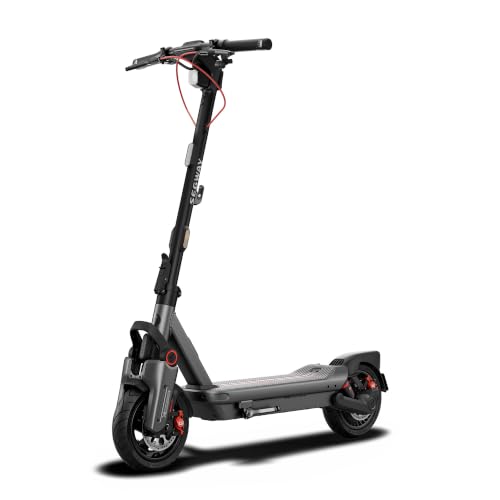
The Segway Max G3 Plus is the 2026 model in Segway’s Max line, and the pitch is simple: a bigger battery and the same kind of fully suspended, 28 mph ride that made the earlier Max G3 popular. Segway lists a 717 Wh battery, an 850 W nominal motor with 2200 W peak, 11-inch tubeless self-sealing tires and hydraulic suspension at both ends. It is a premium commuter for adults who ride real distances, not a lightweight carry-on scooter.
This profile summarizes what Segway says on its own product page, explains what the figures mean in everyday riding and lists what to check before you order. We did not ride this scooter. Our analysis compares the maker’s published specifications with public information on e-scooter rules and battery safety, and we point out where the sources leave gaps. In our electric scooter comparison it ranks first for adult commuters who ride longer distances.
See the Segway Max G3 Plus on Amazon
The Short Version
The G3 Plus is built around range and comfort. According to Segway, ECO mode can cover about 56 miles, though at a jogging pace of 9.3 mph. At the full 28 mph in SPORT+ the figure falls to about 22 miles. That spread is the most important thing to understand about any scooter range claim, and we unpack it below.
The trade-offs are weight, speed and paperwork. At about 56 lb it is not something you want to carry up three flights. The 28 mph top speed is above the limit in many places. And unlike several other Segway models, Segway’s G3 Plus page does not include a certification line, so you should confirm the safety certification yourself.
Who It Is For, and Who Should Skip It
This scooter suits an adult commuter with a ride of roughly 8 to 25 miles each way who can park it at ground level or use an elevator. The big battery means you can ride in a faster mode, skip a charge or two during the week and still have headroom in cold weather, when lithium-ion packs deliver less. Riders who share rough city streets will also appreciate suspension at both ends and tires that seal small punctures.
It is also a good fit for riders who want connected features. Segway lists Apple Find My support, AirLock automatic unlocking, a 2.4-inch color display with navigation (free for the first year, according to Segway), incoming-call notifications, cruise mode and traction control. Segway also notes that Find My is a convenience for locating the scooter, not an anti-theft system.
Skip it if you live in a walk-up apartment and must carry the scooter every day, if you weigh more than 286 lb with your gear, or if your city caps scooters at 15 or 20 mph and you only want a scooter that stays within that. If weight is the problem, look at lighter models in the comparison. If you need a higher payload, the Segway SuperScooter GT3 lists 330 lb, though it is much heavier.
Key Specs According to Segway
| Spec | Segway’s figure |
|---|
| Model | 051602U |
| Motor | 850 W nominal, 2200 W max |
| Top speed | 28 mph |
| Battery | 46.8 V, 15.3 Ah, 717 Wh |
| Range (ECO / DRIVE / SPORT / SPORT+) | About 56 / 36 / 28 / 22 miles |
| Max climbing slope | About 30% |
| Tires | 11-inch tubeless self-sealing, 2.8 inches wide |
| Suspension | Front double hydraulic, rear double adjustable hydraulic |
| Brakes | Front and rear double-action piston disc, plus rear electronic brake |
| Weight | About 56 lb (25.2 kg) |
| Max payload | 286 lb (130 kg) |
| Water resistance | IPX6 body |
| Charging | About 4 hours single, about 3 hours with the optional second adapter |
| Folded size | 48.1 x 23.2 x 23.3 inches |
Range, Explained
Segway publishes a separate range for each riding mode, and each one is paired with a speed: about 56 miles at 9.3 mph in ECO, 36 miles at 15.5 mph in DRIVE, 28 miles at 20 mph in SPORT and 22 miles at 28 mph in SPORT+. The page’s footnotes describe the conditions behind Segway’s figures: ambient temperature around 77°F, a fully charged new battery, a 165 lb rider and a flat paved surface. Segway adds that range varies with load, temperature, road conditions, speed, tire pressure, wind and riding habits, and that battery wear reduces capacity over time.
For planning, treat the headline number as a ceiling. If you weigh 220 lb, ride hills or commute in 30°F weather, expect meaningfully less. A practical rule is to pick the mode you will actually ride in and use that mode’s figure, then leave a 30 percent margin so you are not stretching the battery every day. A 12-mile round trip in DRIVE or SPORT should sit comfortably inside the 28 to 36 mile figures.
Battery size gives another way to sanity-check. Segway lists 717 Wh, which is more than the 597 Wh pack in the Segway Max G3 that came before it. More watt-hours generally means more range at the same speed, which is exactly the difference you see on paper.
Speed and Local Rules
There is no single federal law governing e-scooters in the United States. States and cities decide the speed limit, the minimum age, whether a helmet is required, and whether you may ride on sidewalks, bike lanes or roads. Segway’s own page lists 28 mph as the top speed, with a footnote that it was measured with a full battery and a 165 lb load. That number is well above many local limits, which are often 15 to 20 mph for scooters.
In practice, that means you will often ride the G3 Plus in a lower mode. The ECO, DRIVE and SPORT modes cap the speed at lower levels, which is useful if your city sets a limit. Before you buy, look up your state motor vehicle or transportation department’s page and your city’s micromobility rules. Segway’s GT3 page, for example, says certain states cap the maximum speed of an electric kickscooter for on-road use and names New York, Florida, Arizona and New Jersey as examples. That is a general warning from the maker, not legal advice, and your rules may differ.
Brakes, Tires and Suspension
Braking is handled by double-action piston disc brakes at both ends plus a rear electronic brake. For a scooter that can reach 28 mph and weighs about 56 lb plus its rider, disc brakes are the sensible choice, and the electronic brake adds extra stopping help at the rear. Segway lists a traction control system and a stability enhancement system as well, which are designed to help on slick surfaces and at speed.
The tires are 11 inches tall and 2.8 inches wide, tubeless and self-sealing. Segway recommends keeping pressure between 42 and 48 psi and checking tire pressure and condition every three months. Self-sealing tires can handle small punctures, but Segway says to repair punctured tires promptly. Front and rear hydraulic suspension, with an adjustable rear, should soak up broken pavement and expansion joints better than a rigid scooter, though riders who like a firmer feel may want to experiment with the adjustment.
Portability and Storage
At about 56 lb, the G3 Plus folds to 48.1 x 23.2 x 23.3 inches, which is workable for a car trunk or a closet but not light. Think of it as a scooter you roll, not carry. If you commute by train and face stairs at every stop, a lighter model will serve you better. If you can roll it into an elevator or a garage, the weight matters much less. Segway lists a license plate holder among the box contents.
Charging and Battery Safety
Segway lists built-in 209 W fast charging with a charge time of about 4 hours on a single cable, and about 3 hours if you also use the optional second adapter, which is sold separately. Segway notes that the scooter should be stored where temperatures are not below -14°F, and that if it has been in a place below 32°F you should warm it above 41°F before charging.
Battery fires are a real concern with micromobility products in general. In a statement on a proposed federal battery safety standard, CPSC Commissioner Mary Boyle said these batteries have caused dozens of fatalities and scores of injuries. Sensible habits: charge on a hard, non-flammable surface, use the original charger, do not leave the scooter charging unattended or overnight, and stop using it if the battery swells or smells.
Safety Certification
Segway’s G3 Plus page does not state a certification in its spec table, footnotes or feature text. Some other Segway models, such as the Segway Max G3, state that they were certified by TÜV Rheinland to the UL 2272 standard. Segway’s G3 Plus page has no such statement. We will not claim it is UL certified. If certification matters to you, ask Segway or the seller for documentation and check the label on the scooter and charger. UL 2272 is the electrical safety standard for personal e-mobility devices, and CPSC has urged manufacturers to comply with it.
Warranty
Segway’s store page shows a 2-year limited warranty, subject to terms and conditions. The page also says immersion in liquid is not covered. Read the full terms before you buy, particularly if you plan to ride in wet weather.
Alternatives
If you want nearly the same ride with a smaller battery, the Segway Max G3 lists about 50 miles in ECO and a certification line on its page. If you need a higher load limit and more speed, the Segway SuperScooter GT3 is the heavy-duty option. For lighter, lower-priced rides, see the full electric scooter comparison.
Sources